


 +994 50 667 81 18


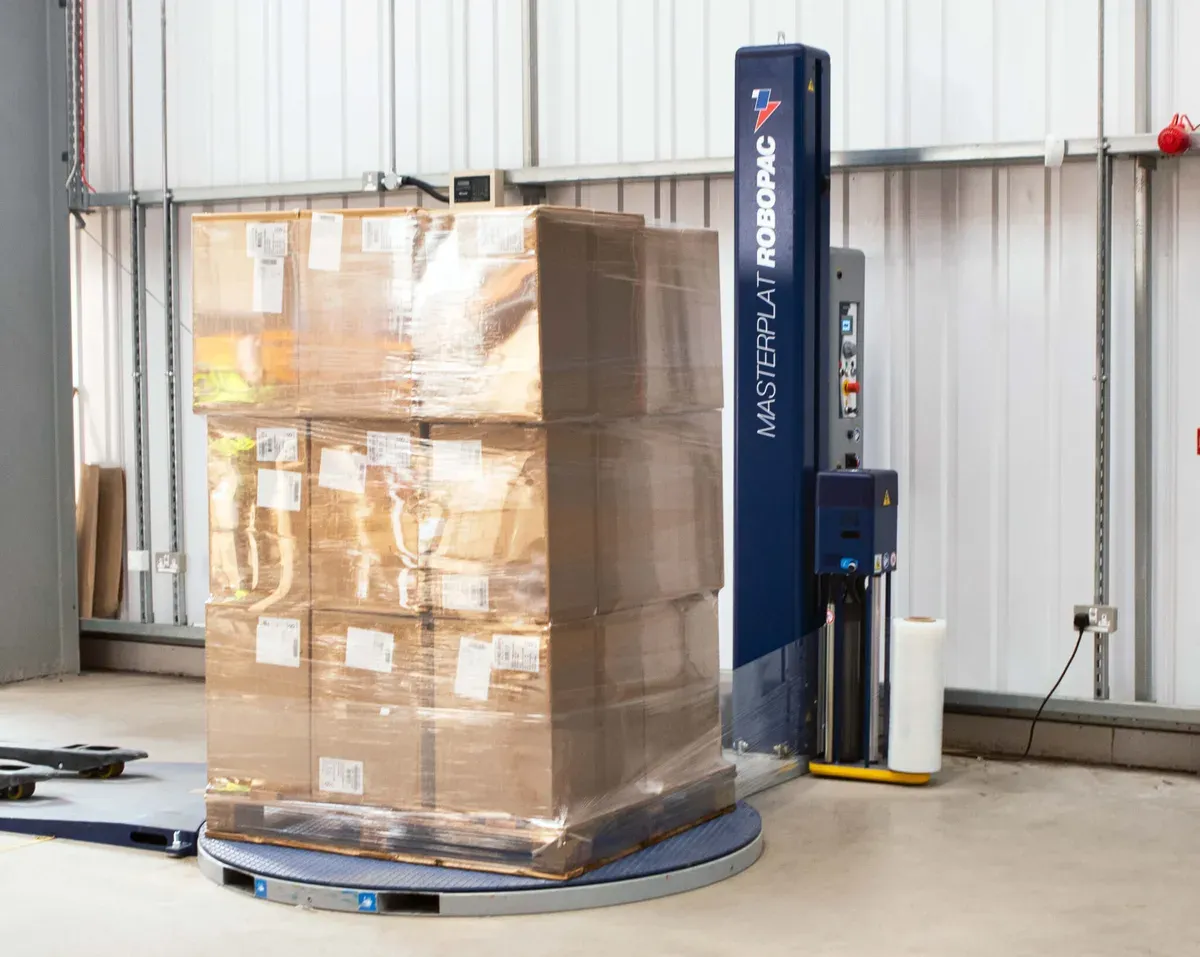
In warehouse management and supply chain logistics, delivering products to their final destination without any damage is paramount. With Azerbaijan rapidly transforming into a major regional transportation hub—driven by the modernization of the Baku International Sea Trade Port and expanding trans-Caspian corridors—pallet wrapping has become a direct factor influencing business profitability. Many companies still operate under the misconception that applying more layers of stretch film manually ensures cargo safety. The reality, however, is quite the contrary.
Excessive and unoptimized film usage not only inflates operational expenses but can also lead to product deformation. Robopac, a global leader in the packaging machinery industry, offers cutting-edge technologies that target and eliminate these inefficiencies at the source.
Cargo Damage During Transport and Its Financial Impact
Statistically, over 70% of product damage occurring during transit is caused by unstable pallet loads or improper wrapping techniques. When a transport vehicle brakes, accelerates, or maneuvers through sharp turns, immense kinetic forces act upon the palletized cargo. If the stretch film fails to provide optimal containment force, the load shifts, collapses, or sustains severe impact.
This structural failure exposes businesses to substantial financial vulnerabilities:
- Total product loss and immediate material damage
- Decreased customer retention and compromised brand reputation
- Prolonged legal and administrative delays associated with insurance claims
- Additional logistics and handling overheads for processing returned goods
What is Robopac's "Cube Technology" and How Does It Cut Film Use by 50%?
Robopac's patented Cube Technology represents a paradigm shift in the industrial stretch wrapping sector. Traditional wrapping machines apply a uniform tension throughout the entire height of the pallet. This lack of adaptability routinely results in film breakage at sharp corners and insufficient containment force in the middle sections.
Cube Technology solves this through a dynamic, multi-tiered approach:
- Variable Containment Force: It applies custom-tailored wrapping tension to distinct zones of the pallet (base, middle, top, and corners).
- Proportional Tension Control: The film's holding force is digitally modulated based on product vulnerability (e.g., lightweight empty containers versus heavy industrial goods).
- Optimized Material Yield: The stretch film is stretched precisely to its performance limit without puncturing, maximizing its elastic recovery memory.
By deploying this advanced software and hardware integration, companies experience a 30% to 50% reduction in stretch film consumption while simultaneously doubling overall load stability.
The Magic of Pre-Stretch Systems
Robopac's high-performance film carriages (such as the PGS and PVS systems) feature motorized dual-roller pre-stretch technology. This mechanism pre-stretches 1 meter of film up to 250% or 400% inside the carriage before it is applied to the load. Consequently, a single meter of raw stretch film yields 4 to 5 meters of usable wrapping material, directly driving down procurement costs.
Comparison Table: Efficiency of Wrapping Methods
The following comparative table illustrates the economic and qualitative differences between conventional wrapping practices and Robopac’s automated solutions:
| Performance Metrics | Manual Hand Wrapping | Standard Local/Chinese Systems | Robopac with Cube Technology |
| Film Consumption (Per Pallet) | High (350 - 500 g) | Medium (200 - 300 g) | Minimum (90 - 130 g) |
| Pre-Stretch Capacity | Negligible (0% - 20%) | Fixed or Limited (100% - 150%) | Dynamic and High (250% - 400%) |
| Load Stability & Security | Poor and inconsistent | Moderate, weak at stress points | Maximum Structural Integrity |
| Risk of Product Crushing | High (Operator variance) | Moderate (Unregulated tension) | None (Ultra-sensitive sensors) |
| Labor Dependency | Fully dependent | Partially dependent | Fully Automated / Minimal Touch |
Choosing the Right Pallet Wrapper for the Azerbaijani Market
Depending on your production volume, throughput requirements, and floor space constraints, Robopac provides diverse equipment configurations:
- Robopac Robot S7 (Mobile Pallet Wrapper): A self-propelled robotic wrapper that navigates around the perimeter of the load. Ideal for warehouses with limited floor space or irregularly shaped, heavy cargo.
- Robopac Masterplat / Rotoplat (Turntable Wrappers): The pallet is placed on a heavy-duty rotating platform. This configuration is perfect for small-to-medium enterprises requiring reliable, high-speed automated throughput.
- Robopac Rototech (Rotary Arm Wrappers): Designed for exceptionally light, unstable, or ultra-heavy loads. The pallet remains stationary on the floor while a mechanical arm rotates smoothly around it.
As the official distributor of Robopac in Azerbaijan, we offer comprehensive structural auditing of your current packaging lines, film performance validation, and authorized technical maintenance. Optimize your logistics footprint and guarantee total cargo protection with Robopac.
Request a Consultation
Our specialists will get back to you as soon as possible to suggest the most suitable automation and packaging solutions for your project.